
Turned away at the departure gate, metres away from the plane?
Detained at a connecting airport or put on the next flight home at your own expense?
Every day, travellers face these nightmares, not because they did anything wrong, but because they didn’t check the visa requirements for countries they were only passing through on their trip.
Transit Visa, Explained
With all focus on planning the perfect itinerary, most people book a connecting flight without giving it a second thought.
It’s all booked on one trip, and the airline handles the rest, right?
Even if your connecting flight is in the UK, you’re not actually visiting the country, you’re just changing planes there. What could go wrong?
This assumption is exactly what causes the problem.
Whether you need a visa to enter your final destination or not, the connecting destination may require a transit visa as well.
The failure to do so can result in nightmarish situations, such as being detained at the airport or being turned away and put on the next flight home.
Layover, Stopover, and Transit
These three words get used interchangeably, but they mean different things.
- Layover – a short connection, typically under 24 hours, where you usually stay at the airport and board another flight some time later.
- Stopover – a longer stop, usually over 24 hours, which often involves leaving the airport to spend time in that city/country or to kill time at an airport hotel.
- Transit – passing through a country on the way to your final destination, regardless of how long you’re there for. This includes a layover or stopover.
All of these three scenarios can trigger visa requirements, whether you’re at the airport for 45 minutes or 48 hours.
What matters is which country you’re passing through, what passport you have, and, critically, whether you set foot outside the secure airside zone.
Why People Assume “Just Passing Through” Means No Visa Needed
The assumption is absolutely understandable, and similar confusion has happened to me in the past.
The word transit implies you’re not really arriving anywhere.
You’re in motion.
This is not the country you’ve chosen to visit; you’re just using its airport as a point on the way. Why would you need any type of paperwork?
This is where most things go wrong.
From an immigration perspective, the moment you enter a terminal, you’re physically present in that country. This means that while you’re within the country’s jurisdiction, you’re obliged to comply with the country’s rules.
Governments set transit visa rules based on many things, including border policies, security arrangements and bilateral agreements. The logic behind the visa rules isn’t always obvious, and it varies from country to country and passport to passport.
Booking through airlines and popular travel platforms comes with a false sense of security.
Most people assume that unless there is a warning in big, bold red letters next to the booking, the route must be safe.
However, airlines and travel sites only check your destination country’s entry requirements, not the type of visas or passports you might need. The responsibility, legally and practically, falls on you.
Airside vs. Landside Transit
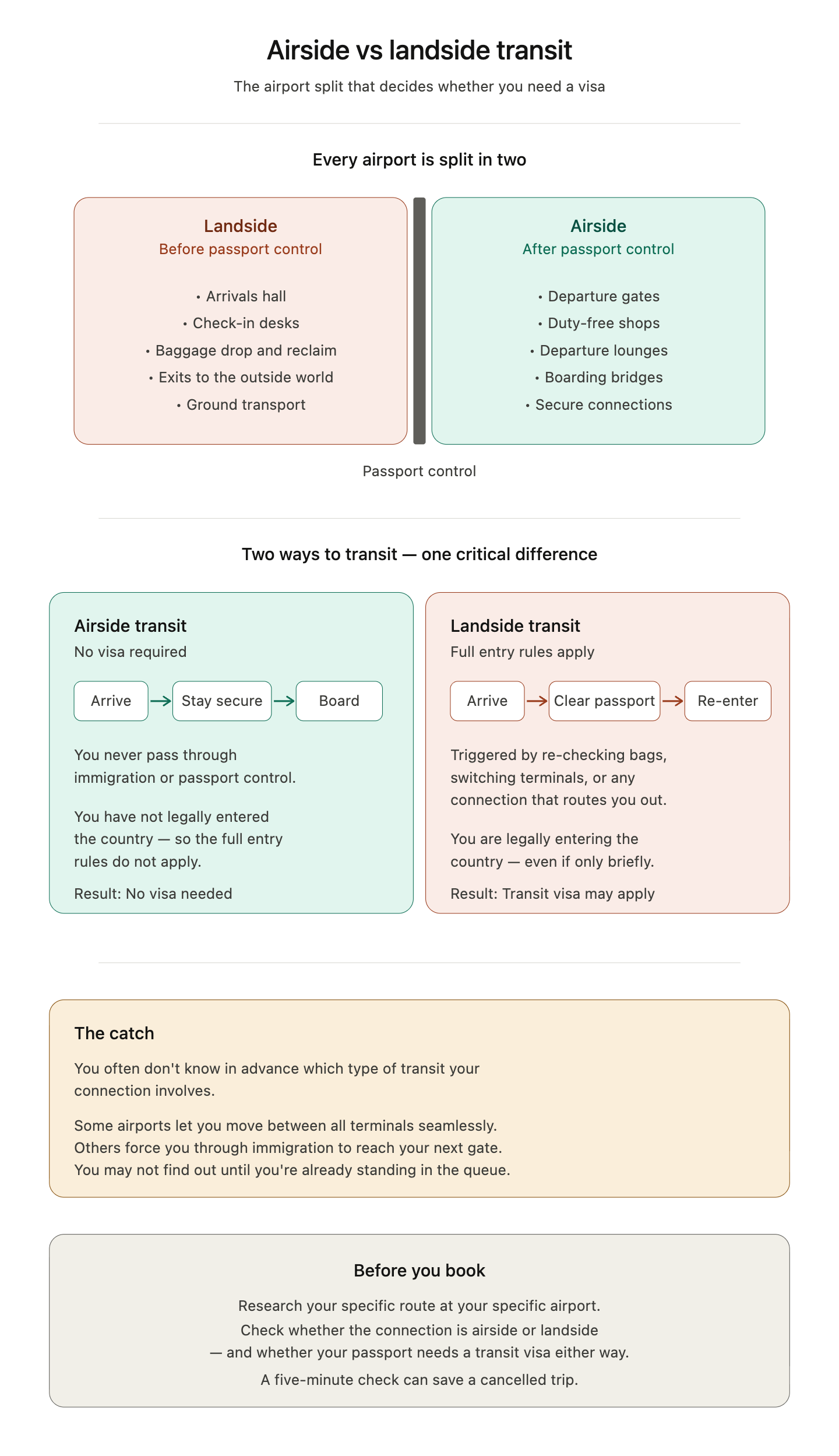
The airside zone is the secure area after you pass passport control, the departure gates, duty-free shops, and departure lounges that you access after clearing security.
The landside zone is everything before that: arrivals halls, check-in desks, baggage drop-off and reclaim, and the exits to the outside world.
In many cases, you land at a connecting airport and stay within the airside zone, boarding your flight without ever passing through an immigration desk or passport control.
This is called an airside transit and requires no visa at all, as you’ve essentially never formally entered the country.
The moment you pass through passport control and your documents get checked, whether to re-check luggage that didn’t transfer automatically, to change terminals through the landside area, or simply because your connection requires it, you have done the landside transit.
At that point, you are legally entering the country, even if only briefly, and the full entry requirements apply.
The issue is that you often don’t know in advance which type of transit the connection involves. At some airports, you can seamlessly move between all terminals without having to pass through any passport control.
Others require passengers to exit through immigration in order to reach the next departure gate. Unless you’ve researched your specific route at your specific airport, you may not know until you’re already there, standing in the wrong queue.
Long Layovers
I flew to Thailand with my family last year, and we had a long (12-hour) layover in Beijing. We had the option to stay at the airport, in the secure transit area on the air side of the terminal.
However, there weren’t many shops or restaurants, and 12 hours felt like a long time to spend locked inside an airport. So, we decided to venture out and explore the city.
Thankfully, I checked China’s transit visa requirements before, and so I knew that it grants travellers from 53+ countries a 6-day visa-free stay, which included my passport too.
This way, we were able to exit and re-enter the airport just with our small bags and spend the entire day exploring Beijing without worrying about getting trapped there.
Editor’s note: China has since expanded this policy. As of December 2024, the transit visa-free stay is 240 hours (10 days) across 55 eligible nationalities and 65 ports of entry. Always check the current list before you travel, as these rules are updated regularly.
If you’re also planning to exit the airport during a long layover and spend some time in the area, definitely research the country’s visa requirements.
The Most Common Transit Visa Traps
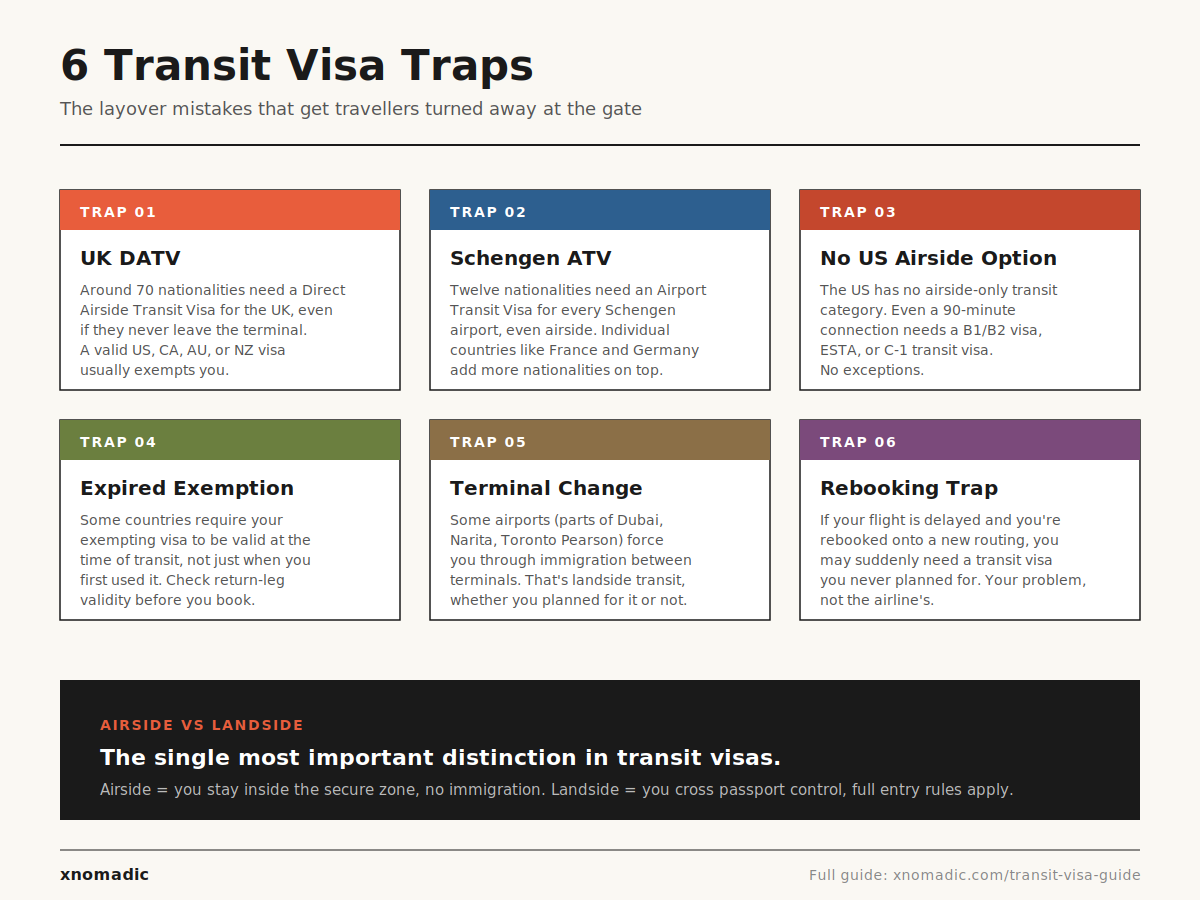
While each person’s circumstances and travel itinerary are different, some common transit visa traps can help you prepare for your trip. These include:
- The UK DATV trap – the UK requires a Direct Airside Transit Visa for many nationalities, even if they never leave the terminal.
- The Schengen trap – a single Schengen layover can require a full Schengen visa for some passport holders.
- The US transit trap – no airside-only transit visa category exists; you need a B1/B2, C-1, or ESTA even to connect.
- The “my visa is valid but expired” trap – some countries require your existing visa to still be valid at the time of transit, not just when you entered.
- The connecting terminal trap – when a layover requires moving between terminals and crossing immigration (e.g., some airports in the UAE, Japan, or Canada).
- The missed connection rebooking trap – getting rebooked onto a different routing that suddenly requires a visa you don’t have.
If you’re connecting through the UK and want to check whether you’d need a DATV or face refusal risk, our UK visa approval probability checker can give you a quick read.
Who Is Most at Risk
- Passport holders from countries with restricted travel (e.g., certain African, South Asian, and Middle Eastern passports).
- People booking cheap flights with multiple stops through budget travel platforms.
- Travellers who rely on airlines or booking platforms to flag visa issues (they often don’t).
- People flying internationally for the first time.
What Airlines and Booking Platforms Won’t Tell You
Airlines and booking platforms only protect themselves, and they often include small print explanations and disclaimers at the bottom of the page, where you can’t see them.
This way, they put all the responsibility on you. Here’s what the fine print doesn’t actually spell out.
They rely on a database called TIMATIC
TIMATIC is a respected, real-time database of international travel document requirements covering passports, visas, health, and customs regulations.
It’s built and maintained by IATA, and it’s what check-in staff use to decide whether to let you board. Used by airlines, travel agents, and government officials, it verifies passenger documentation to prevent fines and ensure compliance for over 700 million passengers annually.
If TIMATIC says you’re missing a document, the airline will deny boarding, no exceptions. Carrying you onward risks a fine and the cost of flying you back, so the incentive to err on the side of refusal is strong.
You can access a consumer version of this database through IATA’s Travel Centre. Most travellers have no idea it exists, but it’s one of the few sources that cross-checks every leg of your journey.
They only check your final destination
When a booking site flashes “no visa required” next to a fare, it’s almost always referring to your final destination.
It’s rarely checking every country in the routing. A ticket with a layover in Istanbul, Frankfurt, or Doha may flag as visa-free even when the transit country will absolutely require paperwork.
Disclaimers do the heavy lifting
Every major airline and booking platform has clauses stating that visa and travel document compliance is the passenger’s responsibility.
If you’re denied boarding, you don’t get a refund. If you’re detained at transit, the airline’s legal obligation ends the moment you’re off their plane.
2026 Updates You Need to Know
Transit rules are shifting faster in 2026 than they have in years. A quick rundown of what changed and what’s coming:
- UK Electronic Travel Authorisation (ETA): the fee rose to £20 on 8 April 2026, up from £16. The ETA now applies to many nationalities who previously didn’t need pre-travel authorisation for the UK. A temporary exemption for airside transit at Heathrow and Manchester is currently in place but may be withdrawn.
- EU Entry/Exit System (EES): launched on 12 October 2025. Replaces passport stamping for all non-EU travellers with a biometric record (fingerprints and photo on first entry). If you’re tracking stay days under the 90/180 rule, our Schengen 90/180 day calculator handles the arithmetic for you.
- EU ETIAS: expected to go operational in late 2026. A pre-travel authorisation for visa-exempt nationalities, costing around €7 and valid for three years.
- China 240-hour visa-free transit: expanded in December 2024 from 72/144 hours to 240 hours (10 days) across 55 eligible nationalities and 65 ports of entry.
None of these replace existing transit visas, but they add new layers of pre-travel paperwork, and all of them have caught travellers off guard in the first months of rollout.
How to Protect Yourself
Researching the exact details of your itinerary before you click purchase is recommended.
Only that way you truly know what’s to come, and have enough time to prepare.
Here’s a working checklist you can run through before every international booking:
- Check your passport validity. Most countries require at least six months of validity beyond your travel dates, and some transit countries check this too.
- Look up visa requirements for every country in your routing, not just your destination. Use the official government website of each transit country, or cross-check via IATA’s Travel Centre.
- Identify which transits are airside and which are landside. Your booking confirmation or the airline’s website usually tells you. If it doesn’t, call and ask. The exact question is: “Do I go through immigration on my layover?”
- Check whether any existing visa exempts you. A valid US, UK, Canadian, Australian, or New Zealand visa exempts many nationalities from UK DATV and Schengen ATV requirements, but only if it’s still valid and your airline can verify it.
- Apply early. Transit visas often take two to three weeks, and the application frequently requires a biometric appointment at a visa application centre.
- Keep printed copies. Check-in staff don’t always have access to e-visa verification systems. A physical printout of an approved visa or ETA has saved more boardings than people realise.
- Factor in 2026 rule changes. The UK ETA, the EU’s EES, and the upcoming ETIAS all affect travellers who previously didn’t need anything. Check every routing as if it were your first time, even if you’ve flown it before.
If you’re open about where you go next, our random destination picker filters destinations by visa-friendliness for your passport.
Transit Visa FAQ
Do I need a transit visa for a layover?
Sometimes. It depends on your passport, the country you’re connecting through, and whether you stay airside or cross into landside. Some nationalities need a visa even for an airside layover (for example, about 70 nationalities need a UK Direct Airside Transit Visa). Others are visa-free for short airside connections but need one the moment they have to collect luggage or change terminals.
What happens if I don’t have a transit visa?
The airline will deny boarding at your origin airport. You won’t be allowed on the flight, you won’t get a refund, and rebooking is your responsibility.
If you somehow board without the required paperwork, you’ll be detained at the connecting airport and put on the next flight back, at your own cost.
Is a transit visa the same as a tourist visa?
No. A transit visa is valid only for the duration of your layover (typically up to 24 to 48 hours depending on the country) and does not allow sightseeing, business activities, or extended stays.
A tourist visa covers actual visits and lasts much longer, but is also more expensive and harder to get.
How long does it take to get a transit visa?
Two to three weeks is typical for most countries, including biometric appointment time.
Some countries offer priority processing for an additional fee. Always apply well ahead of your travel date, and don’t assume a same-country appointment slot will be available on short notice.
Can I leave the airport during a transit?
Only if the country allows it for your passport, and only if you have the correct document. An airside-only transit visa does not permit leaving the airport.
Many countries have dedicated “visa-free transit” programmes (China, Qatar, and the UAE all run versions of this) that let you leave the airport for a fixed window, usually between 24 and 240 hours depending on nationality and port.
Does a valid US visa exempt me from other transit visas?
In many cases, yes. A valid US visa (along with Canadian, Australian, or New Zealand visas) exempts many nationalities from the UK Direct Airside Transit Visa and the Schengen Airport Transit Visa.
The catch: the visa must still be valid at the time of transit, not just when you first used it, and your airline has to be able to verify it electronically at check-in.
The Bottom Line
A connecting flight is not a neutral point on a map.
The moment you step off one plane and wait for another, you’re inside a country’s legal system, with all the obligations that brings.
Airlines know this. Booking platforms know this. They just don’t make it your headline problem until it becomes one.
Ensuring you have a valid passport for at least 6 months after your travel date, knowing what the visa requirements are for each country you’re transiting and visiting, and having the documents, legal forms and online platforms researched before you travel are essential steps in ensuring you won’t get affected by visa traps and have a stress-free trip abroad.
Five minutes of research before you book will tell you everything you need to know. Skipping that check to save time is the single most expensive shortcut in travel.

Leave a Reply